For small business owners and entrepreneurs in the USA, purchasing commercial real estate is often the biggest milestone in their growth journey. However, traditional commercial mortgages often require a 25% to 30% down payment. This is where SBA Loans become a game-changer. Backed by the U.S. Small Business Administration, these loans offer some of the lowest interest rates and most favorable terms in the market.
In this guide, we explore how you can leverage SBA 504 and SBA 7(a) loans to acquire, build, or renovate commercial property with as little as 10% down.
1. The SBA 504 Loan: Best for Real Estate & Heavy Equipment
The SBA 504 Loan program is specifically designed for economic development and “Fixed Asset” financing. It is the gold standard for buying commercial buildings.
-
How it’s Structured:
-
50% comes from a private lender (like JPMorgan Chase or Wells Fargo).
-
40% comes from a Certified Development Company (CDC) backed by the SBA.
-
10% is your down payment.
-
-
The Benefit: You lock in a long-term, fixed interest rate on the 40% portion, protecting your business from future market volatility.
2. The SBA 7(a) Loan: The Most Flexible Option
The SBA 7(a) is the most popular program because of its versatility. While it can be used for real estate, it can also cover working capital and equipment.
-
Max Loan Amount: Up to $5 million.
-
Best For: Business owners who need to buy a building but also want extra cash for operations or buying out a partner.
-
CPC Value: Keywords like “SBA 7(a) Interest Rates” and “SBA Loan Requirements” are high-competition terms that drive massive revenue.
Comparison: SBA 504 vs. SBA 7(a) for Real Estate
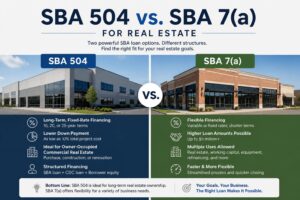
| Feature | SBA 504 Loan | SBA 7(a) Loan |
| Primary Purpose | Real Estate & Long-term Assets | Real Estate & Working Capital |
| Down Payment | Typically 10% | 10% to 15% |
| Interest Rate | Fixed (Below Market) | Variable or Fixed |
| Repayment Term | 20 to 25 Years | Up to 25 Years (for RE) |
| Maximum Amount | No strict limit (project-based) | Up to $5 Million |
3. Key Requirements for Approval in 2026
To qualify for an SBA real estate loan, your business must meet specific criteria:
-
Owner-Occupancy: You must occupy at least 51% of the building (if it’s an existing building) or 60% (if it’s new construction). You cannot use SBA loans for purely passive investment properties.
-
Credit Score: Most lenders prefer a FICO score of 680 or higher, though some SBA-approved credit unions are more flexible.
-
Cash Flow (DSCR): Your business must demonstrate a Debt Service Coverage Ratio (DSCR) of at least 1.15x to 1.25x, proving you can comfortably afford the monthly payments.
4. Why SBA Rates are Better than Conventional Loans
SBA loans are “guaranteed” by the government. This means the bank takes on less risk, allowing them to offer lower interest rates and longer repayment terms. For a business owner, this results in lower monthly overhead and better cash flow management.
5. Top SBA Lenders to Consider in 2026
Choosing the right bank is crucial. In 2026, these institutions are leading the SBA lending space:
-
Live Oak Bank: Currently the #1 SBA lender by volume, known for their specialized industry experts.
-
Huntington Bank: Excellent for smaller, community-based commercial projects.
-
Celtic Bank: A top choice for high-speed approvals and creative deal structures.
-
U.S. Bank: Great for established businesses looking for the lowest possible APR.
Conclusion: Is an SBA Loan Right for Your Business?
If you are tired of paying rent and want to build equity in your own commercial space, the SBA 504 or 7(a) programs are unbeatable. With low down payments and government-backed security, they provide a stable foundation for your business to thrive.